
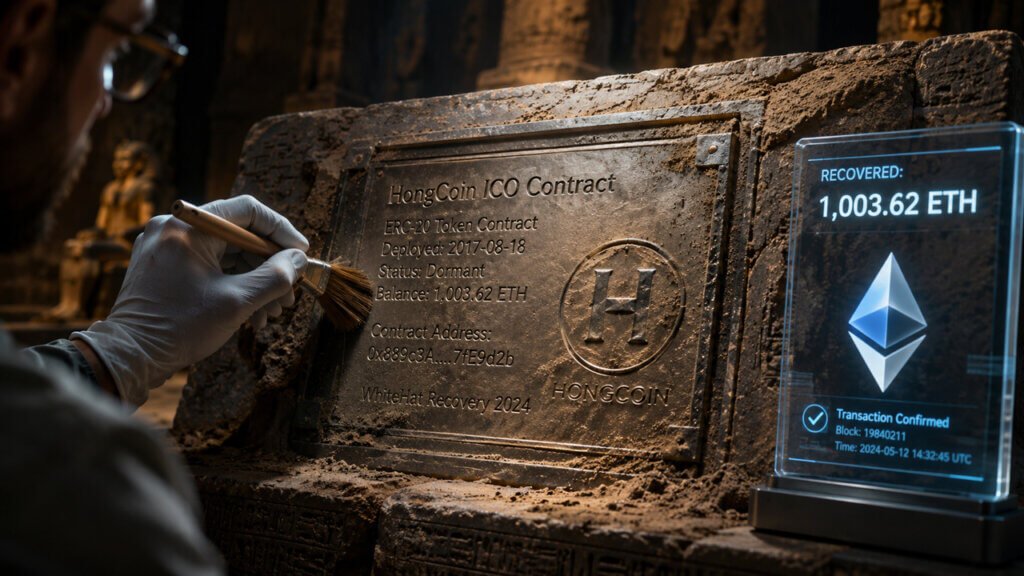
A failed Ethereum ICO from 2016 has suddenly returned to the spotlight after a white-hat researcher helped unlock 1,003 ETH that had been trapped for nearly nine years. The recovery has become one of the more unusual stories in Ethereum’s history because the same type of old smart contract behavior that created the problem also helped open a path to fix it.
The case involves HongCoin, an early Ethereum project that raised funds during the ICO boom but failed to meet its funding target. Investors were supposed to receive refunds through the project’s smart contract, but a contract accounting issue blocked some larger holders from claiming their ETH. Years later, a researcher known as 0xFlorent found a way to use an old admin function and the original multisig path to make those claims possible again.
A Forgotten ICO Finds a Recovery Route
HongCoin’s token sale began in 2016, during a time when Ethereum was still young and many projects were experimenting with token-based fundraising. The project was described as a decentralized venture fund, but it did not reach its funding goal. Under normal conditions, contributors should have been able to use the refund function inside the contract to reclaim their ETH.
However, the refund process did not work properly for every investor. Over time, some earlier refunds reduced a global counter inside the smart contract. This created a strange situation where certain larger holders still had valid claims, but the contract treated their balances as too large compared to the remaining counter. As a result, the refund function rejected them even though they were the people the refund system was supposed to protect.
For years, the ETH remained stuck. The contract did not disappear, the balances did not vanish, and Ethereum’s chain history remained unchanged. That long memory is one of Ethereum’s most powerful features, but in this case, it also preserved a technical mistake that kept investors locked out of their own refunds.
How 1,003 ETH Became Accessible Again
The recovery became possible because the old HongCoin contract still had another path inside it. A multisig-restricted admin function could adjust balances under the project’s original management structure. This function was not open to anyone. It required the involvement of the original multisig, which created an important boundary between a responsible recovery and a simple exploit.
0xFlorent identified that this admin route could be used in a very specific way to reset blocked holder balances low enough for the refund check to pass. In simple terms, one old bug-like behavior helped undo the damage caused by another old bug. The result was not a typical hack where funds were stolen from a contract. Instead, it was closer to smart contract archaeology, where a researcher studied old code, found a forgotten path, and coordinated with the rightful control structure to reopen refunds.
The recovered amount was 1,003.62 ETH, worth close to $2 million based on Ethereum’s price around the time of the recovery. For the 48 investors who had been blocked for years, the event turned a forgotten failed ICO into a rare example of old funds becoming claimable again.
Why the Old Bug Mattered
The technical reason behind the recovery goes back to how older Solidity contracts handled arithmetic. Before Solidity 0.8.0, arithmetic operations could behave differently unless developers added their own safety checks. In modern Solidity, many overflow-style issues are handled more safely by default, but older contracts were written under different assumptions.
That matters because Ethereum smart contracts are immutable once deployed. If a developer made a mistake in 2016, that mistake can still exist today unless the contract had an upgrade or recovery mechanism. In HongCoin’s case, the refund bug stayed alive for years. But the old admin path also stayed alive, and that made the recovery possible.
This is why the HongCoin case is so unusual. Many stuck-fund situations do not have a working control path, cooperative signers, or a clean way to identify rightful claimants. Here, the combination of an old contract, remaining permissions, a white-hat researcher, and on-chain evidence created a rare chance to repair a broken refund system.
A Recovery, Not a General Exploit Template
Although the story sounds dramatic, it should not be treated as a simple method for unlocking other old Ethereum contracts. The HongCoin recovery depended on very specific conditions. The original multisig had to participate, the contract logic had to contain a usable admin route, and the investors’ claims had to remain traceable.
Without those factors, similar attempts could become risky or even harmful. Contract archaeology can expose old weaknesses, but exposing a weakness is not the same as creating a safe recovery path. If a dormant contract has no active permission structure or no clear claimant list, trying to interact with it may create more risk than benefit.
This is why the ethical side of the HongCoin recovery is just as important as the technical side. The researcher did not simply drain the contract. The process involved coordination with the original control path so that blocked investors could become eligible to reclaim their ETH. That difference separates a white-hat recovery from an opportunistic attack.
Ethereum’s Long Memory Cuts Both Ways
The HongCoin case is a reminder that Ethereum remembers everything. Old transactions, old balances, old permissions, and old mistakes can remain active long after the people behind a project have moved on. This persistence is part of what makes blockchains reliable, but it also means poorly written contracts can keep causing problems years later.
Ethereum has already seen major stuck-fund and recovery debates in its history, from The DAO crisis to the Parity multisig incident. HongCoin is much smaller in size, but it fits into the same broader lesson. Code deployed on-chain can outlive teams, trends, websites, and market cycles.
For investors, this case shows that some trapped funds may not be permanently lost if there is still a valid recovery path. For developers, it is a warning that smart contract design must include careful accounting, safe permissions, and clear recovery planning. A small bug can become a years-long problem, and sometimes only another forgotten piece of code can help fix it.
What This Means for Ethereum Users
The unlocking of 1,003 ETH does not mean that all old ICO funds can be recovered. It does show, however, that Ethereum’s old contracts may still contain unresolved stories. Some may hold risks, some may hold lost value, and a few may still contain forgotten mechanisms that can be used responsibly.
HongCoin’s recovery is hopeful for the investors who waited nearly nine years, but it is also a warning for the wider ecosystem. Ethereum does not forget bad code. Sometimes, it also does not forget the escape hatch.
FAQs
What happened with the dormant Ethereum ICO?
A failed Ethereum ICO called HongCoin unlocked 1,003.62 ETH after a white-hat researcher found a recovery path in its old smart contract. The funds had been trapped for nearly nine years due to a refund bug.
Who helped recover the stuck ETH?
A white-hat researcher known as 0xFlorent identified the recovery method and coordinated with the original HongCoin multisig to make blocked investors eligible for refunds.
Why were the funds stuck for so long?
The refund function had an accounting issue that rejected some larger holders after earlier refunds reduced a global token counter. This blocked valid investors from reclaiming their ETH.
Was this recovery a hack?
It was not a typical hack. The recovery used an old contract path with the involvement of the original multisig, making it a coordinated white-hat recovery rather than a theft.
Can other old Ethereum contracts be recovered the same way?
Not necessarily. The HongCoin case depended on very specific conditions, including a usable admin function, cooperation from the original multisig, clear investor claims, and remaining funds inside the contract.