
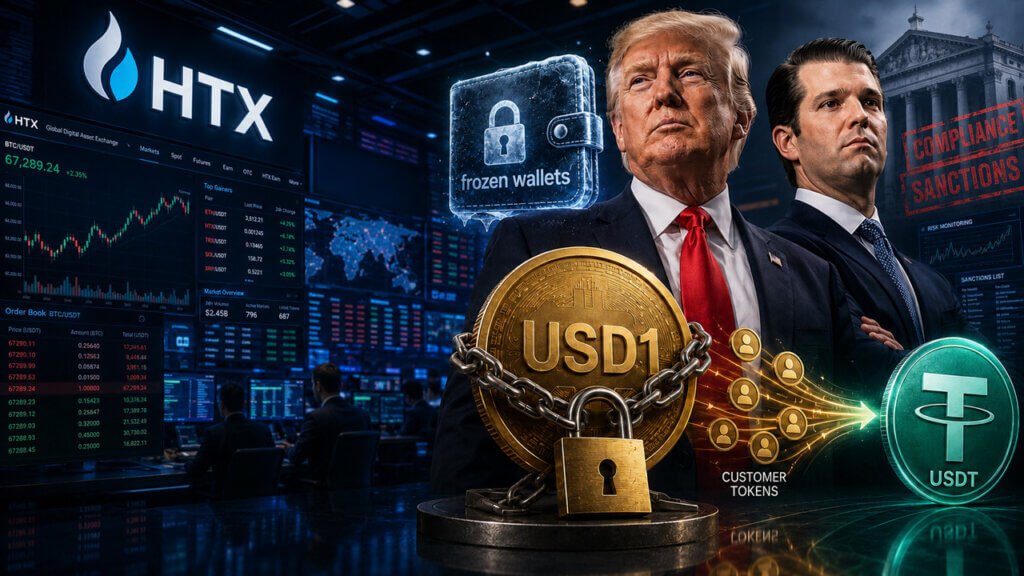
A crypto dispute linked to Trump-backed World Liberty Financial has moved beyond political headlines and directly into customer accounts. The conflict intensified after HTX decided to delist USD1 and convert eligible retail balances into USDT following a wallet freeze connected to World Liberty Financial’s on-chain controls. What started as a compliance and governance fight has now become a much larger warning about stablecoins, centralized control, and the risk ordinary users face when token issuers can freeze wallets at the protocol level.
The story matters because USD1 is not just another small experimental token. It is a fiat-backed stablecoin tied to a politically connected crypto project and promoted as a serious digital dollar product. Stablecoins are supposed to offer reliability, liquidity, and confidence. But when a stablecoin issuer can freeze exchange-controlled wallets, the market is forced to ask a difficult question: how safe are customer balances when compliance battles spill into the infrastructure itself?
Why HTX Is Moving USD1 Users Into USDT
HTX’s response was direct. The exchange moved to remove USD1 from its platform and convert eligible retail customer balances into USDT at a one-to-one rate. That decision shows how seriously the exchange viewed the freeze. Instead of waiting for the dispute to be resolved, HTX chose to protect users by moving them into a more widely used stablecoin.
The exchange has argued that the blocked wallets contained ordinary retail customer funds, not illicit assets. That detail is important because the freeze did not only affect a single suspected actor. It reportedly hit exchange-controlled wallets, which can include funds belonging to many users. In this kind of structure, the wallet may belong to the exchange, but the economic ownership of the assets can be spread across thousands of customers.
This is where the controversy becomes serious. If a stablecoin issuer freezes a wallet controlled by an exchange, ordinary customers may become collateral damage. They may not have done anything wrong, but their funds can still be caught inside a compliance action between companies, regulators, and politically connected projects.
The Compliance Argument Behind the Freeze
World Liberty Financial appears to have acted in response to sanctions and compliance concerns connected to HTX-related entities. Stablecoin issuers often argue that freeze controls are necessary to block criminal activity, sanctioned networks, terrorist financing, hacks, and money laundering. In traditional finance, this kind of compliance control is expected. In crypto, it creates a much deeper debate because users also expect open access and self-custody principles.
The problem is not simply that a freeze function exists. Many major stablecoins already have the technical ability to block addresses in serious legal or security cases. The bigger issue is how broad the freeze becomes and how clearly the issuer explains the standard used to trigger it. If the evidence is not transparent, exchanges and users may feel that the issuer has too much unilateral power.
That is why this case has attracted attention. HTX says the freeze affected customer funds and wants the restrictions reversed. World Liberty Financial has not fully clarified the exact evidence standard that led to the action. Until that happens, the market is left with uncertainty over whether the freeze was a targeted compliance action or an overreach that placed normal users at risk.
A Family Crypto Feud Becomes a User Problem
The political connection makes the situation even more sensitive. World Liberty Financial is associated with the Trump family, and the project has already faced scrutiny because of its high-profile backers. When a politically connected stablecoin project freezes wallets connected to a major exchange, the issue becomes larger than one token listing. It becomes a test of trust, neutrality, and control in crypto markets.
The feud also links back to broader tensions involving Justin Sun, HTX, and past disputes around World Liberty Financial’s tokens. But this current case is different because it is not only about one investor, founder, or governance fight. It now affects exchange liquidity and retail customer balances. That makes the stakes much higher.
Crypto users may not care about the legal details between large players. They care about access to their money. If a wallet freeze can force an exchange to delist a stablecoin and convert user balances, then users will start asking whether politically connected tokens carry extra risk.
The Stablecoin Control Problem
This case exposes one of the biggest contradictions in modern crypto. Stablecoins are marketed as digital dollars for open markets, but many fiat-backed stablecoins rely on centralized issuers with administrative controls. Those controls can be useful for compliance, but they also create a power structure that looks very different from Bitcoin or fully decentralized assets.
When users hold a centralized stablecoin, they are not only trusting the blockchain. They are also trusting the issuer, the legal system behind the issuer, the compliance process, and the exchange where the token is traded. If any part of that chain breaks, the user can be affected.
For institutions, freeze controls may make stablecoins more acceptable because they reduce legal risk. For retail users, the same controls can feel dangerous because access can be restricted without direct involvement in any wrongdoing. That tension will likely become more important as stablecoins grow into payment networks, trading collateral, and digital cash products.
What This Means for Crypto Users
For crypto users, the lesson is clear: not all stablecoins carry the same risk. A token may hold a one-dollar peg, but that does not mean the user has full control in every situation. Issuer controls, blacklist functions, sanctions exposure, exchange custody, and political connections can all affect access.
HTX’s move into USDT may protect users in the short term, but it also shows how quickly exchanges can act when confidence in a stablecoin issuer breaks. If World Liberty Financial wants USD1 to gain deeper trust, it will need to explain its freeze policies clearly, prove that customer funds are not unfairly trapped, and show that compliance actions will not create broad collateral damage.
The bigger message is that stablecoin adoption depends on trust as much as technology. If users believe their funds can become part of a political or corporate dispute, they may move to more liquid and established alternatives. Trump’s family crypto feud has now shown how wallet freezes can move from legal theory into real customer accounts, and that is a warning the entire stablecoin market cannot ignore.
FAQs
What happened between World Liberty Financial and HTX?
World Liberty Financial froze several HTX-controlled wallets linked to USD1, leading HTX to delist USD1 and convert eligible retail customer balances into USDT at a one-to-one rate.
Why did HTX convert USD1 into USDT?
HTX said it acted to protect users after wallet restrictions affected exchange-controlled addresses. By converting eligible balances into USDT, the exchange aimed to reduce customer exposure to the dispute.
What is USD1?
USD1 is a fiat-backed stablecoin connected to World Liberty Financial, a crypto project associated with the Trump family. It is designed to track the value of the U.S. dollar.
Why are wallet freezes controversial?
Wallet freezes are controversial because they allow token issuers to block transfers from certain addresses. This may help with compliance, but it can also affect ordinary users if exchange wallets or shared custody addresses are frozen.
What should crypto users learn from this case?
Users should understand that centralized stablecoins can carry issuer-control risk. Even if a token is dollar-backed, access can be affected by compliance actions, exchange disputes, sanctions, or administrative freeze controls.