
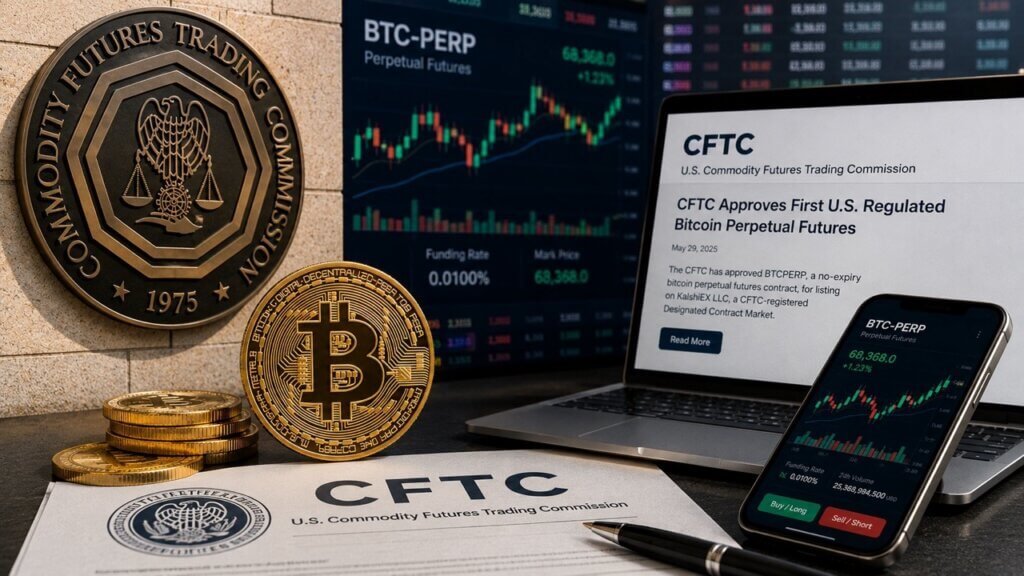
Bitcoin perpetual futures have taken a major step toward becoming part of the regulated US market after the Commodity Futures Trading Commission opened new paths for crypto derivatives access. The move is important because perpetual futures are one of the largest and most active trading products in the global crypto market, yet most of that activity has traditionally happened outside the United States.
The latest regulatory development gives Bitcoin perps a clearer US route, but it does not automatically mean liquidity will move onshore overnight. The real question is whether regulated platforms can offer enough access, margin efficiency, product depth, and competitive pricing to pull traders away from offshore exchanges that already dominate crypto derivatives.
A Major Step for US Bitcoin Perpetual Futures
The CFTC approved KalshiEX to list BTCPERP, a cash-settled Bitcoin perpetual futures contract with no fixed expiration date. This matters because a true perpetual contract is different from a normal futures contract. Traditional futures expire on a set date, while perpetual futures are designed to keep trading continuously.
At the same time, Coinbase Financial Markets received a separate staff-level route that could allow US clients to access certain Deribit derivatives through its registered futures commission merchant structure. Together, these two developments show that US regulators are no longer treating Bitcoin perps only as an offshore product. They are now testing how this market can exist inside a regulated framework.
For the crypto industry, this is a big shift. Perpetual futures have long been the engine of crypto trading volume, price discovery, leverage, and funding-rate activity. Bringing even part of that market under US oversight could change how Bitcoin trades during volatile periods.
Why Perpetual Futures Matter So Much
Perpetual futures are popular because they allow traders to take long or short positions without worrying about contract expiration. Instead of rolling contracts every month or quarter, traders can keep exposure open as long as they meet margin requirements.
The key feature of a perp is the funding mechanism. If the perpetual contract trades above the spot Bitcoin price, long traders usually pay short traders. If it trades below spot, shorts pay longs. This creates an economic incentive for the perp price to stay close to the underlying Bitcoin market.
This system has made perps extremely powerful in crypto. They are flexible, liquid, and active around the clock. But they also carry major risks. High leverage, forced liquidations, unstable funding rates, and crowded positioning can turn small Bitcoin price moves into sharp market swings. That is why regulators are focused not only on access, but also on how leverage, margin, collateral, and customer protection will work.
Kalshi and Coinbase Open Two Different Doors
Kalshi’s approval and Coinbase’s route are not the same thing. Kalshi received a formal CFTC Commission order for a Bitcoin perpetual futures contract listed on a registered US exchange. That gives it stronger regulatory weight because the product itself was approved under the agency’s process.
Coinbase’s path is different. It involves a staff interpretation and no-action position connected to Deribit products. This means Coinbase may be able to route certain customer access through its registered structure, but the relief is more conditional and fact-specific. It depends on compliance controls, margin safeguards, disclosures, and the relationship between Coinbase’s affiliated entities.
This distinction matters because one route tests whether a US exchange can directly list a true Bitcoin perp, while the other tests whether US customers can reach global crypto derivatives liquidity through a regulated broker structure. Both are important, but they carry different legal strength and different limits.
The One Catch: Liquidity Must Follow
The biggest catch is liquidity. Approval alone does not make a market successful. Traders will only move if the regulated products are competitive with offshore venues. That means tight spreads, deep order books, reliable funding rates, smooth execution, strong collateral options, and easy access.
Offshore exchanges became dominant because they offered speed, leverage, product variety, and 24/7 crypto-native trading. US-regulated platforms must now prove they can offer a safer environment without making the product too slow, too expensive, or too limited.
If regulated Bitcoin perps launch with weak liquidity or strict limits that make them unattractive to active traders, the approval may become more symbolic than transformative. It would still be an important legal precedent, but it would not immediately shift the center of crypto derivatives trading back to the United States.
Why Bitcoin’s Market Structure Could Change
If liquidity does move into regulated US channels, Bitcoin’s market structure could change in several ways. More trading activity could become visible to regulators, institutions may gain more confidence, and price discovery could become less dependent on offshore exchanges.
This could also help reduce some of the risks linked to opaque leverage. In the current global crypto market, large liquidation events often begin on offshore platforms where leverage is high and monitoring is less transparent. A regulated US perp market may not eliminate liquidations, but it could make the system easier to supervise and understand.
For institutional investors, this development could be especially important. Many firms cannot trade on offshore venues due to compliance restrictions. A regulated Bitcoin perp gives them a tool to hedge, speculate, manage exposure, or build structured strategies without leaving the US regulatory environment.
Why the CFTC Is Moving Carefully
The CFTC’s approval appears carefully limited. The reasoning depends heavily on Bitcoin’s deep, active, continuous spot market. Bitcoin trades across many venues around the clock, which helps support a reference price and allows arbitrage to keep the perp connected to spot.
That does not mean every crypto asset will automatically get the same treatment. Smaller tokens may not have enough liquidity, market depth, or reliable pricing to support a similar contract. The CFTC’s approach suggests that future approvals may depend on each asset’s market structure, trading quality, and product design.
This is important because the industry may want perps for many assets, but regulators are likely to move slowly. Bitcoin may be the first major test because it has the strongest market depth and the most established institutional infrastructure.
What Comes Next for Bitcoin Perps
The next stage will depend on real market adoption. Traders will watch Kalshi’s launch terms, Coinbase’s timeline for broader Deribit access, retail availability, leverage limits, fees, funding quality, and how quickly liquidity builds.
If the products work well, the US could finally begin reclaiming a major part of the crypto derivatives market. If they remain limited, offshore exchanges will continue to dominate. The green light is important, but the market will decide whether it becomes a real shift or just another regulatory milestone.
FAQs
What are Bitcoin perpetual futures?
Bitcoin perpetual futures are derivatives that let traders take long or short exposure to Bitcoin without a fixed expiration date. They use funding payments to keep the contract price close to the spot Bitcoin price.
What did the CFTC approve?
The CFTC approved KalshiEX to list BTCPERP, a cash-settled Bitcoin perpetual futures contract. Coinbase also received a separate conditional route for US access to certain Deribit derivatives through its registered structure.
Why is this important for Bitcoin?
This is important because perpetual futures are one of the largest parts of global crypto trading. A regulated US route could bring more transparency, institutional access, and oversight to Bitcoin derivatives.
What is the biggest challenge now?
The biggest challenge is liquidity. Regulated US platforms must compete with offshore exchanges that already offer deep order books, high activity, broad access, and crypto-native trading tools.
Will all crypto perps now be approved in the US?
Not automatically. The CFTC’s reasoning depends heavily on Bitcoin’s deep and active market. Other assets may face stricter review based on liquidity, pricing reliability, and market structure.