
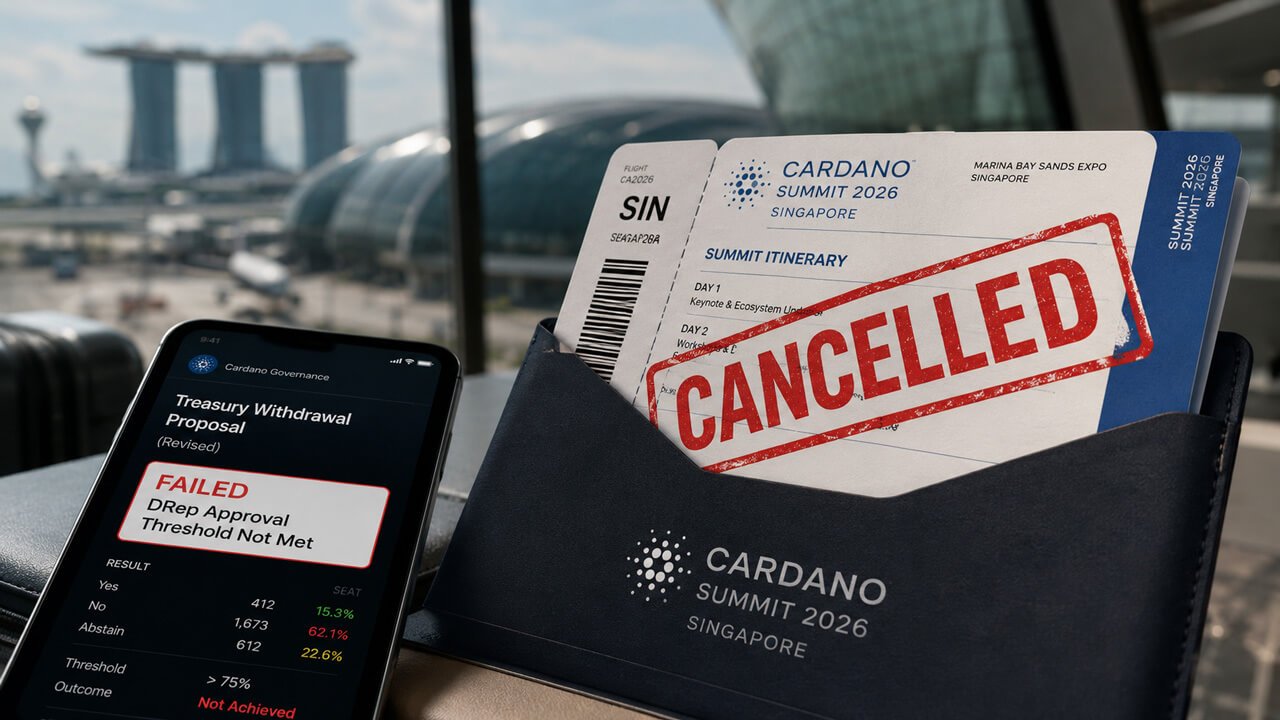
Cardano’s 2026 Summit in Singapore has been canceled after a treasury funding proposal failed to reach the required governance approval threshold. The decision has turned what looked like a normal event budget request into a major test of Cardano’s decentralized governance model. It also shows both the power and the risk of giving community representatives real control over ecosystem spending.
The canceled Summit was expected to take place in Singapore on October 5 and 6, 2026. It was planned as a two-day event focused on builders, governance participants, enterprise outreach, institutions, and regulatory conversations. But after the revised treasury proposal expired below the required DRep threshold, the event was removed from the calendar.
A Treasury Vote Stops Cardano’s Main Event
The Cardano Foundation had requested 7.8 million ADA to fund the 2026 Singapore Summit. Based on the proposal’s assumptions, the budget was equal to around $1.95 million. The funding request had already been revised after community feedback, with the Foundation reducing the budget and separating it from EMURGO’s TOKEN2049 sponsorship proposal.
Despite those changes, the Summit proposal did not pass. It received 64.61% DRep support, which was still below the required 67% threshold for treasury withdrawals. That small gap was enough to stop the funding and cancel the event.
This is the key lesson from the vote. A proposal can receive majority support and still fail if it does not reach Cardano’s required governance threshold. In this case, the result showed that Cardano’s treasury system is not symbolic. It can block even high-profile requests from central ecosystem institutions.
Why the 67% Threshold Matters
Cardano’s governance system gives Delegated Representatives, known as DReps, a major role in deciding how treasury funds are spent. For treasury withdrawals, approval requires a high threshold rather than a simple majority. That design is meant to prevent careless spending and force proposals to earn broad support before public funds are released.
In theory, this protects ADA holders. It means the treasury cannot be easily used for weak, unclear, or overpriced proposals. It also forces organizations to explain budgets, respond to community criticism, and prove that spending creates measurable value.
But the Summit cancellation shows the other side of the same system. A high threshold can protect against waste, but it can also slow down execution. When a proposal misses by a small margin, the result can still be final. In this case, the consequence was not only a failed vote. It was the loss of a major public-facing Cardano event.
DReps Showed Real Power
The vote proved that DReps can restrain even major Cardano institutions. That matters because many blockchain governance systems look decentralized on paper but still allow core teams or foundations to dominate decision-making. Cardano’s result was different. The Foundation proposed the Summit, revised the ask, reduced costs, and still had to accept the community governance outcome.
This gives Cardano a strong decentralization argument. The network can now say that its treasury process has real teeth. If community representatives do not support a proposal enough, funding does not move, even when the request comes from an important ecosystem organization.
However, that same power creates responsibility. DReps are not only voting on numbers. They are shaping Cardano’s public calendar, business development strategy, institutional outreach, and community visibility. When they reject funding, they also decide what the ecosystem will not do.
The Summit Was More Than a Community Gathering
The Singapore Summit was not presented only as a celebration or networking event. The proposal described a business and ecosystem development strategy. One day was planned for builders, DReps, governance sessions, and workshops. Another day was designed for enterprise, institutional, and regulatory audiences.
The proposal also targeted measurable outcomes, including 1,200 attendees, 250 enterprise marketing-qualified leads, and 50 strategic meetings within 45 days after the event. These targets showed that the Summit was meant to support Cardano’s wider market presence, not just its community culture.
Because of that, the cancellation carries strategic weight. Cardano loses a dedicated Summit during a major Singapore conference window, even though EMURGO’s separate TOKEN2049 sponsorship proposal passed. This means the ecosystem may still have some Singapore presence, but not the full dedicated Summit that the Foundation wanted.
Governance Discipline Comes With Coordination Risk
The vote is a governance win and a coordination warning at the same time. It is a win because the treasury system worked as designed. The community reviewed the proposal, the budget was revised, and the DReps still chose not to approve it at the required level. That is real fiscal discipline.
But it is also a warning because public blockchain ecosystems need speed, planning certainty, and external credibility. Events, partnerships, developer programs, and enterprise outreach often require months of preparation. If funding decisions remain uncertain until late in the process, partners and organizers may hesitate to commit.
This is especially important for Cardano because the ecosystem is trying to prove that decentralized governance can support serious real-world growth. If major initiatives repeatedly struggle to pass, critics may argue that Cardano’s governance is strong at saying no but weaker at executing on time.
What This Means for ADA Holders
For ADA holders, the canceled Summit shows that Cardano’s treasury is not an unlimited spending account. That may reassure investors who worry about wasteful budgets or insider-driven funding. A disciplined treasury can protect long-term value if it forces every proposal to justify its cost.
At the same time, ADA holders must also consider the cost of missed opportunities. A canceled Summit may reduce short-term spending, but it may also reduce visibility, institutional conversations, developer engagement, and ecosystem momentum. Good governance must do more than stop bad spending. It must also help approve valuable spending quickly enough to matter.
This is the balance Cardano now needs to prove. The system has shown that it can veto. The next challenge is showing that it can fund high-impact work without creating unnecessary delays or uncertainty.
Cardano’s Next Governance Test
The Summit cancellation may lead future proposals to become more detailed, more measurable, and more carefully separated from adjacent sponsorships. Teams asking for treasury funds will likely need tighter budgets, clearer return expectations, stronger community communication, and better timing.
That could make Cardano governance stronger over time. But if the process becomes too slow or too difficult, the ecosystem may struggle to act when opportunity appears. Decentralized governance is powerful only if it can combine accountability with execution.
Cardano’s 2026 Summit cancellation shows that DReps can shape the ecosystem in public. Now the real test is whether that power can produce better decisions, not just fewer expenses.
FAQs
Why was the Cardano 2026 Summit canceled?
The Cardano 2026 Summit was canceled because its treasury funding proposal failed to reach the required DRep approval threshold. The proposal received majority support but missed the 67% requirement.
How much funding did the Summit proposal request?
The revised proposal requested 7.8 million ADA, which was estimated at around $1.95 million based on the proposal’s ADA price assumption.
What role did DReps play in the cancellation?
DReps voted on the treasury withdrawal proposal. Since the vote reached 64.61% support but needed 67%, the proposal expired below the required threshold and funding was not approved.
Did all Cardano Singapore-related proposals fail?
No. EMURGO’s separate TOKEN2049 sponsorship proposal passed, while the dedicated Cardano Summit proposal failed. This means Cardano may still have some Singapore presence, but not the full Summit event.
What does this mean for Cardano governance?
The vote shows that Cardano governance has real power to control treasury spending. It also raises questions about whether the ecosystem can approve major events, partnerships, and strategic initiatives quickly enough to support growth.