
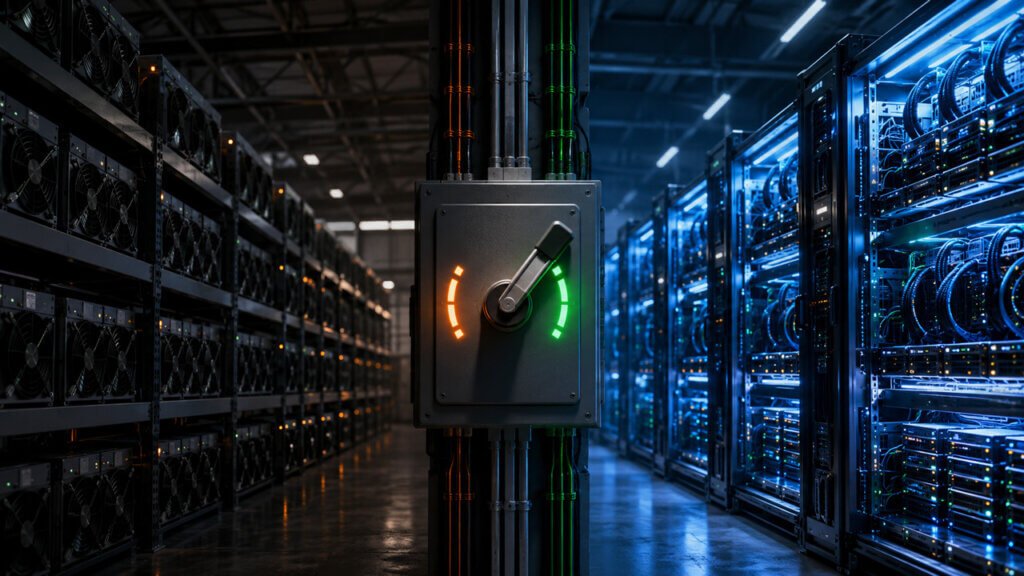
Bitcoin miners are entering a new phase where the most valuable asset may no longer be only hash rate, machines, or mined BTC. The real prize is power. As artificial intelligence demand explodes, miners with large energy contracts, permitted sites, cooling systems, and grid connections are discovering that their infrastructure may be worth more as AI compute campuses than traditional Bitcoin mining facilities.
This shift is changing how investors value mining companies. In the past, miners were mainly judged by how much Bitcoin they produced, how efficient their ASIC fleets were, and how low their electricity costs could go. Now, the market is asking a different question: who controls power that can be converted into high-performance computing capacity for AI?
Why Power Has Become the New Mining Prize
Bitcoin mining has always depended on electricity. The cheaper and more reliable the power, the stronger a miner’s profit margin. But AI has changed the value of that same infrastructure. Large technology companies need enormous amounts of energy to train models, run data centers, and support cloud-based AI services. This has created a shortage of available power sites that are already connected, permitted, and ready for heavy compute loads.
Bitcoin miners happen to control exactly the kind of infrastructure AI companies need. Many miners already operate large campuses with power access, land, transformers, cooling experience, and industrial-scale operations teams. That gives them a major advantage over companies trying to build AI data centers from scratch.
This is why the mining business is no longer just about producing Bitcoin. A miner with 300 megawatts of powered infrastructure may now have two choices. It can deploy ASIC machines and compete for Bitcoin block rewards, or it can lease power and space to AI customers under long-term contracts. In the current market, the AI option can look more stable and more profitable.
AI Contracts Are Changing Miner Economics
The shift became clearer after major mining companies began signing large AI and high-performance computing deals. These contracts show that miners can turn their power campuses into leased infrastructure for AI workloads. Instead of relying only on Bitcoin price, mining difficulty, transaction fees, and hash price, they can earn revenue through contracted compute or hosting agreements.
This is important because Bitcoin mining revenue is volatile. A miner’s income can change quickly when Bitcoin’s price falls, network hash rate rises, or energy costs increase. AI hosting can offer a different kind of income stream. It may provide longer-term visibility, more predictable margins, and a stronger story for public market investors.
For miners, the choice becomes a financial comparison. If mining Bitcoin produces less revenue per unit of power than AI hosting, capital will naturally move toward AI. This does not mean every miner will abandon Bitcoin, but it does mean miners with strong power assets may start treating mining as only one possible use of their infrastructure.
Hash Price Is the Key Pressure Point
Hash price measures how much revenue miners earn for a unit of computing power. When hash price is high, Bitcoin mining becomes more attractive. When hash price falls, miners look for other ways to monetize their infrastructure. The latest market conditions have made this comparison more difficult for traditional mining.
Fidelity’s analysis suggested that many modern mining fleets would need a much higher hash price to compete with AI hosting economics. In simple terms, Bitcoin mining revenue would need to rise significantly before it could match the value of leasing power capacity to AI customers. That creates a powerful incentive for miners to explore AI conversion.
This pressure becomes even stronger after Bitcoin halvings. Each halving reduces the block subsidy miners receive, forcing them to become more efficient or find new revenue streams. If AI demand keeps growing while mining rewards become harder to earn, more companies may decide that the best use of their power is no longer only Bitcoin mining.
What This Means for Bitcoin’s Hash Rate
If miners move more power toward AI, Bitcoin’s network hash rate growth could slow. This does not mean the network would suddenly become weak, but it could change the pattern of mining expansion. In recent years, miners constantly added machines to chase block rewards and compete for market share. If AI absorbs some of that power capacity, fewer new ASICs may come online.
A slower hash-rate growth rate could actually help remaining miners by reducing competition. When fewer machines are fighting for the same block rewards, mining difficulty may adjust and margins can improve. However, it also changes the long-term structure of the industry because the largest and most power-rich miners may become hybrid infrastructure companies instead of pure Bitcoin producers.
This could separate the industry into two groups. One group will remain focused on Bitcoin mining, optimizing ASIC efficiency and low-cost energy. The other group will become energy and compute landlords, using mining as just one part of a broader AI and data-center strategy.
Investors Are Repricing Mining Companies
The stock market has already started treating some miners differently. Companies with credible AI strategies, strong power pipelines, and data-center conversion plans are attracting more attention than miners that only depend on Bitcoin production. This shows that investors may now value power access more than mined coins.
That shift can be positive for miners with strong infrastructure, but it also creates risk. AI data centers require different cooling, networking, uptime standards, capital investment, and customer relationships compared to Bitcoin mining. Not every mining site can be easily converted. Some locations may have cheap power but lack the reliability, fiber access, or technical standards needed for advanced AI workloads.
This means the winners will likely be miners that can prove their power is not only cheap, but also commercially useful for high-performance computing.
Bitcoin Mining Is Becoming an Energy Business
The deeper lesson is that Bitcoin mining has always been an energy business, but AI is making that reality impossible to ignore. The machines may change from ASICs to GPUs, and the revenue may shift from block rewards to hosting contracts, but the core asset remains the same: access to large-scale power.
For Bitcoin, this creates both pressure and opportunity. Some miners may leave part of the network to chase AI revenue, but stronger miners may become more financially stable by diversifying. If AI income reduces forced Bitcoin selling, it could even help some miners hold more BTC over time.
Bitcoin miners are no longer fighting only for coins. They are fighting for energy, infrastructure, and the right to decide where power creates the highest return. In the age of AI, the miner that controls power may control the future of the industry.
FAQs
Why is power becoming more valuable for Bitcoin miners?
Power is becoming more valuable because AI companies need massive energy capacity for data centers and high-performance computing. Bitcoin miners already control many large powered sites, making their infrastructure attractive for AI use.
How is AI changing Bitcoin mining?
AI is giving miners another way to earn revenue from their power infrastructure. Instead of only using electricity to mine Bitcoin, miners can lease or convert sites for AI hosting and data-center workloads.
What is hash price in Bitcoin mining?
Hash price is the revenue miners earn for a unit of computing power. When hash price is low, mining becomes less profitable, making alternatives like AI hosting more attractive.
Will AI reduce Bitcoin’s hash rate?
AI could slow future hash-rate growth if some miners move power capacity away from Bitcoin mining. However, the network would adjust difficulty over time, and remaining miners could benefit from less competition.
Can all Bitcoin miners switch to AI?
No, not all mining sites are suitable for AI. AI data centers need reliable power, cooling, fiber connections, strong uptime standards, and major capital investment. Only miners with the right infrastructure can make the transition successfully.