
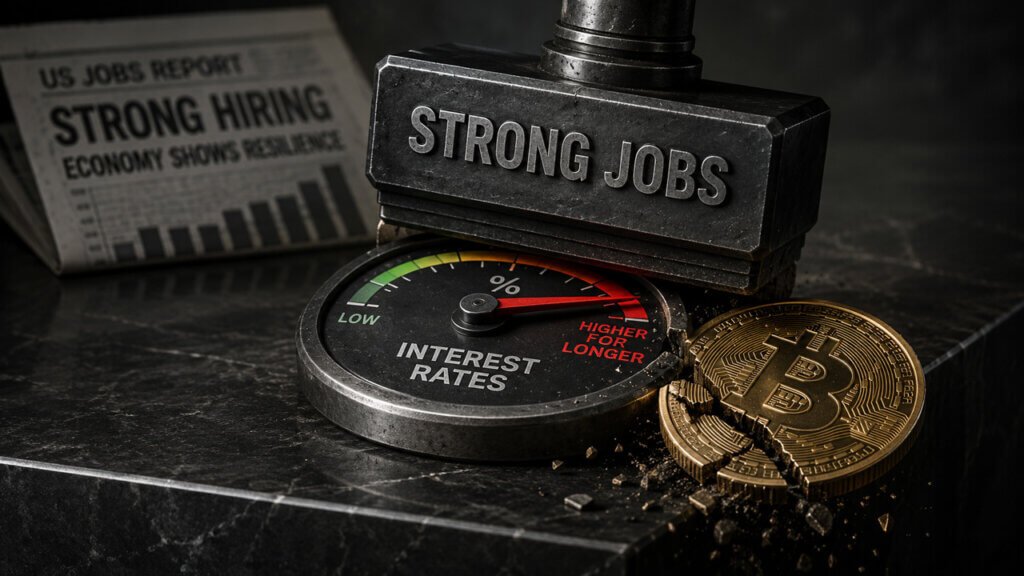
The May jobs report delivered exactly the kind of number that sounds positive for the economy but painful for borrowers, investors, and Bitcoin traders. The U.S. economy added 172,000 jobs in May, far above what many analysts expected, while the unemployment rate stayed at 4.3%. On the surface, that looks like a strong labor market. More jobs usually mean more income, more spending power, and more confidence. But in today’s market, strong jobs data can create the opposite reaction because it gives the Federal Reserve fewer reasons to cut interest rates.
That is why a strong jobs report quickly became a problem for risk assets. Investors had been hoping the economy would slow enough to give the Fed cover to lower rates. Instead, the labor market showed strength, and that pushed markets to price in a longer period of tight monetary policy. For Bitcoin, which often benefits when liquidity expectations improve, the report became a bearish signal.
Why Strong Jobs Can Mean Higher Rates
The Federal Reserve is focused on inflation, employment, and financial conditions. When the labor market stays strong, the Fed can argue that the economy does not need rate cuts yet. If people are still getting hired and unemployment is stable, policymakers may worry that cutting rates too early could reignite inflation.
This is the key point many people miss. A good jobs report is not always good for markets. In a normal environment, strong hiring can support stocks and consumer spending. But when inflation is still a concern, strong hiring can make the Fed more cautious. It tells policymakers that demand may still be strong, wages may remain sticky, and consumers may keep spending. All of that can make inflation harder to bring down.
Because of this, the May jobs report reduced hopes for quick rate cuts. Traders who were betting on easier monetary policy now have to rethink the timeline. If the Fed keeps rates higher for longer, borrowing remains expensive, liquidity stays tighter, and speculative assets face more pressure.
Why Loans and Mortgages Stay Expensive
Higher rates do not only affect Wall Street. They directly hit everyday borrowers. When the Fed keeps interest rates elevated, banks and lenders pass those costs to consumers. That means mortgages, credit cards, personal loans, business loans, and auto financing all remain more expensive.
For homeowners, this can mean higher monthly mortgage payments and weaker housing affordability. For small businesses, it can mean delayed expansion because borrowing money costs more. For consumers, it can mean credit card balances become harder to manage, and car loans become less attractive. In simple words, a strong jobs report can keep the cost of money high.
This is why the May report matters beyond the headline job number. The 172,000 figure gives the Fed room to wait. If the economy were clearly weakening, rate cuts would become easier to justify. But with hiring still strong, the Fed may prefer to keep policy tight until inflation moves closer to its target.
Why Bitcoin Reacted Badly
Bitcoin dropped after the report because crypto traders are extremely sensitive to liquidity expectations. When markets expect rate cuts, Bitcoin often benefits because lower rates can weaken the dollar, reduce bond yields, and push investors toward riskier assets. But when rate cuts are delayed, Bitcoin loses one of its strongest macro tailwinds.
The logic is simple. Higher rates make cash and bonds more attractive. Investors can earn yield in safer assets instead of taking risk in Bitcoin, altcoins, or tech stocks. At the same time, expensive borrowing reduces market liquidity. Less liquidity usually means less money flowing into speculative assets.
Bitcoin’s move toward the $60,000 area showed that traders were quickly pricing out the idea of near-term Fed relief. The market was not only reacting to the job number itself. It was reacting to what that number means for the next Fed meeting, future rate decisions, and the broader liquidity cycle.
The Fed Meeting Becomes the Next Big Test
The next major focus is the Federal Reserve’s upcoming policy meeting. After the May jobs report, traders will watch every word from Fed officials for signs of whether rate cuts are still possible this year or whether the central bank is preparing to stay restrictive for longer.
If the Fed signals patience, Bitcoin may remain under pressure. A higher-for-longer message would support the dollar and Treasury yields, both of which can weigh on crypto. But if the Fed suggests that inflation is still cooling despite strong jobs, markets may regain some confidence.
The problem for Bitcoin is that the jobs report gave the Fed less urgency to act. That means crypto traders may need another catalyst, such as softer inflation data, weaker consumer spending, or signs of stress in credit markets, before rate-cut expectations return strongly.
What This Means for Crypto Investors
For crypto investors, the May jobs report is a reminder that Bitcoin is not trading in isolation. Even though Bitcoin has its own supply cycle, ETF flows, mining economics, and long-term adoption story, macro conditions still matter. When liquidity tightens, Bitcoin can fall even if the long-term narrative remains strong.
The 172,000 jobs number does not destroy Bitcoin’s bull case, but it delays the easy-money story that many traders were hoping for. If rates stay high, Bitcoin may need stronger spot demand, ETF inflows, institutional buying, or on-chain accumulation to offset macro pressure.
In the short term, the market will likely remain focused on inflation data, Treasury yields, the dollar, and Fed commentary. If those signals continue to point toward higher rates, Bitcoin could stay volatile. But if economic data starts cooling again, traders may quickly return to the rate-cut narrative.
The May jobs report showed that good economic news can still be bad market news. For workers, 172,000 jobs is a sign of strength. For borrowers, it means expensive loans may last longer. For Bitcoin, it means the liquidity relief trade has been pushed further away.
FAQs
Why did the May jobs report hurt Bitcoin?
The May jobs report hurt Bitcoin because strong hiring reduced expectations for near-term Federal Reserve rate cuts. When rates stay higher for longer, liquidity tightens and investors become less willing to buy risky assets like Bitcoin.
How many jobs did the U.S. add in May?
The U.S. economy added 172,000 jobs in May, while the unemployment rate stayed at 4.3%. The number was stronger than many market expectations.
Why do strong jobs numbers affect interest rates?
Strong jobs numbers show that the economy is still holding up. That gives the Federal Reserve less reason to cut rates quickly, especially if inflation remains a concern.
Why do higher rates make loans more expensive?
Higher rates increase borrowing costs for banks and lenders. Those costs are passed to consumers through higher mortgage rates, credit card rates, car loans, personal loans, and business loans.
Can Bitcoin recover if rates stay high?
Bitcoin can recover if demand is strong enough, especially through ETF inflows, institutional buying, or long-term accumulation. However, high rates usually make recovery harder because they reduce liquidity and increase competition from safer yield-bearing assets.